How AI + HITL is Solving Malaysia's Claims Backlog Problem
Examining how the combination of artificial intelligence and human oversight is dramatically reducing claims processing times across Malaysian insurers and TPAs.
MediLink-Global Research Team
Healthcare Technology Analysis
Malaysia's healthcare insurance industry processes millions of claims annually, yet a significant portion still faces delays of 5–15 business days — far exceeding the 3-day benchmark set by Bank Negara Malaysia's best practice guidelines. The root cause is not a lack of technology, but a misalignment between automation ambition and operational reality.
The traditional approach to claims automation has been binary: either fully automate (with high error rates on complex cases) or keep humans in the loop for everything (slow and expensive). MediLink-Global's Hybrid AI + Human-in-the-Loop (HITL) model breaks this false dichotomy by intelligently routing claims based on complexity, risk profile, and data completeness.
How the HITL Model Works
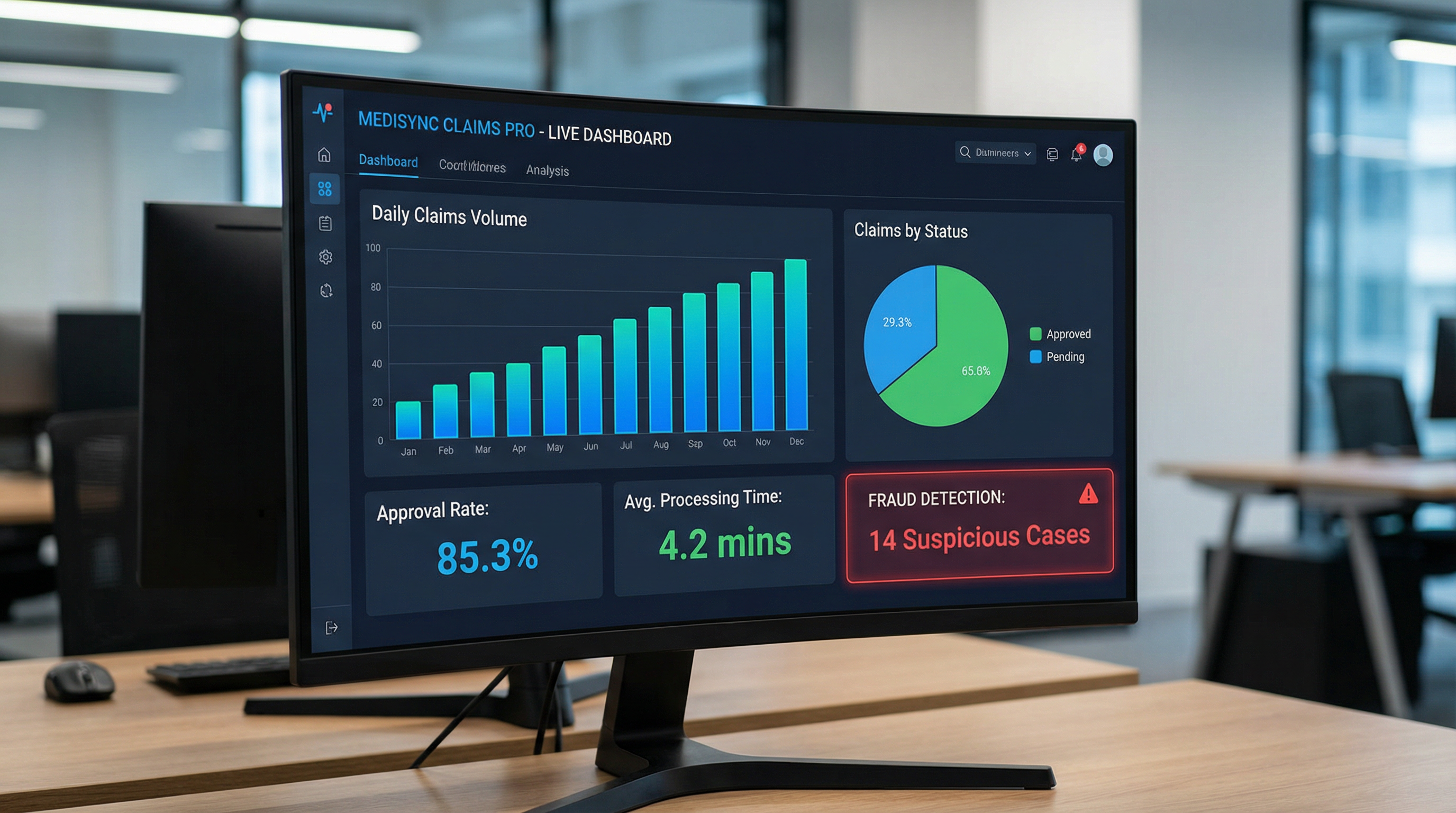
In MediLink-Global's ECCS platform, every incoming claim is first assessed by an AI triage engine that evaluates over 200 parameters — including diagnosis codes, treatment protocols, historical patterns, and provider behaviour. Claims that score above a confidence threshold of 92% are processed automatically with zero human intervention. Claims below this threshold are routed to specialised human reviewers with AI-generated recommendations and flagged anomalies.
The results are striking. In a 12-month deployment with a major Malaysian life insurer, the HITL model achieved:
The Human Element Remains Critical
A common misconception is that AI will eventually replace human reviewers entirely. In healthcare claims, this is neither desirable nor feasible. Medical necessity determinations, complex surgical billing disputes, and fraud investigations require contextual judgment, ethical reasoning, and regulatory awareness that current AI systems cannot replicate reliably.
What AI excels at is pattern recognition at scale — identifying when a claim deviates from expected norms, flagging potential duplicate billing, cross-referencing diagnosis-treatment alignment, and predicting the likelihood of a claim being valid. Human reviewers then apply judgment to the cases AI has pre-analysed, dramatically increasing their throughput and accuracy.
Implementation Considerations for Malaysian Payors
For insurers and TPAs considering a HITL implementation, the key success factors are: (1) data quality — AI models are only as good as the historical data they are trained on; (2) change management — reviewer workflows must be redesigned, not just augmented; (3) regulatory alignment — all automated decisions must maintain an auditable trail for Bank Negara and MOH compliance; and (4) continuous model retraining — medical billing patterns evolve, and models must be updated regularly.
MediLink-Global's ECCS platform has been designed with all four factors in mind, offering a managed service model where the AI models are continuously maintained by our data science team, removing the burden from in-house IT teams.
Key Takeaways
- HITL achieves 78% straight-through processing while maintaining accuracy on complex cases
- Average claims turnaround reduced from 8.7 days to 1.2 days in production deployments
- Human reviewers are 3.4x more productive when focused on AI-triaged complex cases
- Continuous model retraining is essential as medical billing patterns evolve
Interested in implementing these insights?
Request a Demo